Attendance Management App
A facial recognition attendance system built with Python, OpenCV, and Qt Designer leveraging machine learning algorithms (SIFT, LBPH, HOG, SVM, XGBoost) to accurately identify employees from a real-time camera feed and automatically log attendance.
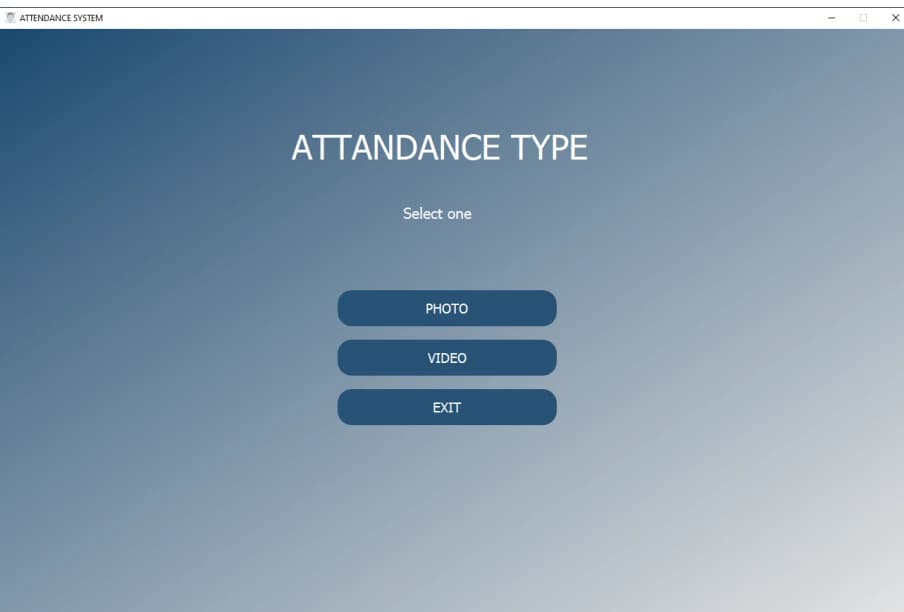
For my academic project, I developed a smart attendance management system that uses facial recognition to automate employee check-ins. The goal was to replace manual attendance tracking with a fast, accurate, and contactless solution. The application captures a real-time camera feed and processes each frame using computer vision techniques. I implemented multiple algorithms working together: HOG (Histogram of Oriented Gradients) for face detection, SIFT (Scale-Invariant Feature Transform) for feature extraction, and LBPH (Local Binary Pattern Histogram) for face recognition. For classification, I integrated SVM and XGBoost with L1 normalization to improve prediction accuracy. We trained the system using a large dataset of faculty student photos that we collected and processed. Once a face is detected and matched, attendance is automatically logged into an SQLite database with timestamp and user details. The desktop GUI was built with Qt Designer, providing an intuitive interface to view the live camera feed, manage employee records, and review attendance history. The entire system runs locally, ensuring data privacy and fast processing without internet dependency. This project combined computer vision, machine learning, and GUI development into a practical real-world application.
My Tasks
- Designed and developed the full attendance system as an academic project
- Built a desktop GUI using Python and Qt Designer with real-time camera feed display
- Implemented face detection using HOG (Histogram of Oriented Gradients)
- Developed feature extraction pipeline using SIFT (Scale-Invariant Feature Transform)
- Built face recognition system using LBPH (Local Binary Pattern Histogram)
- Integrated SVM and XGBoost classifiers with L1 normalization for improved accuracy
- Collected and processed a large dataset of faculty student photos for training
- Designed SQLite database schema for storing employee records and attendance logs
- Implemented automatic attendance logging upon successful face match
- Optimized image processing pipeline for real-time performance using NumPy and OpenCV
What I Learned
- Technical Growth: This project was my deepest dive into computer vision and machine learning. I learned how different algorithms serve different purposes — HOG excels at detecting faces, SIFT captures distinctive features regardless of scale or rotation, and LBPH handles recognition by comparing texture patterns. Combining these with SVM and XGBoost classifiers taught me how to build a pipeline where each component strengthens the overall accuracy.
- Working with real-time video processing pushed me to optimize performance — using NumPy for fast array operations and tuning OpenCV parameters to balance speed and accuracy. I also gained hands-on experience collecting and preprocessing a real dataset, learning how data quality directly impacts model performance.
- Soft Skills & Professional Growth: As an academic project, I had to manage my own deadlines and research independently when I hit roadblocks. Debugging computer vision issues taught me patience — sometimes a model fails because of lighting, angles, or data quality, not code errors.
- This project showed me that building something "smart" requires understanding both the theory and the practical limitations. I learned to test in real conditions early, not just on clean datasets.
Project Info
- Type
- Featured Project
- Technologies
- 15
- Tasks
- 10
- Learnings
- 4
Screenshots (1)
Related Projects


Interested in working together?
I'm available for freelance projects and full-time opportunities.
Hire Me